P04-21-2024I take my dog pretty much everywhere with me. Every vacation. Every hike. Every road trip. She even comes to the grocery store, although she waits patiently in the Jeep like a normal dog instead of me slapping a fake service-dog vest on her and marching her through the produce department. I can limp through life perfectly well without pretending my Catahoula rescue dog is a licensed medical professional.

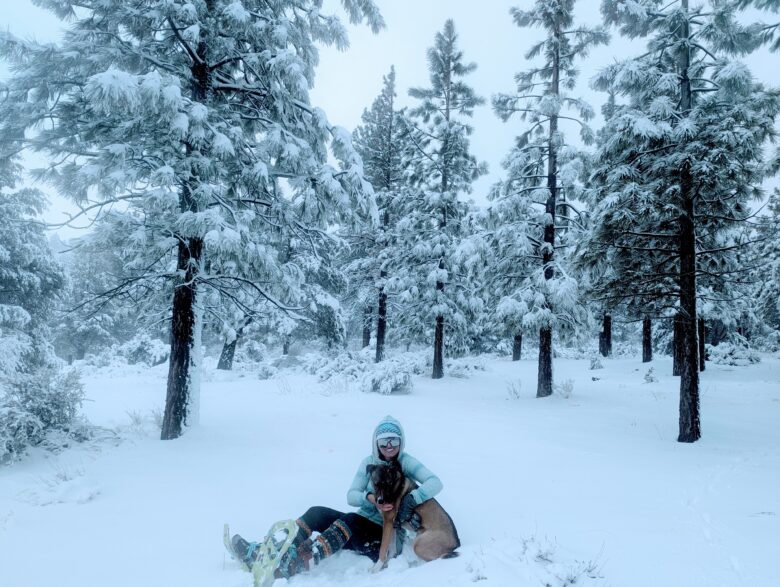
So yes, as Big Bear Lake’s Outdoor Adventure Queen, my Adventure Pup is out playing in the snow with me constantly from December through March. Luna, my Catahoula rescue, loves snowy days almost as much as I do, which is saying something considering I spend the winter guiding Big Bear snowshoe tours, dog-friendly snow hikes and guided snow play experiences through the San Bernardino Mountains. Book this hike now!
But Luna is basically a mountain dog at this point. Not every visiting dog is prepared to launch itself enthusiastically into two feet of fresh powder.
If you are driving up to Big Bear Lake this winter with your favorite family doggo for their first snowy vacation, the first question is not, “Where can I take adorable Instagram photos of Muffin wearing goggles?”
The first question is: Does my dog actually like being cold?
If your dog acts personally betrayed every time you suggest a walk in the rain, a three-hour snow adventure may not be their dream vacation. Start slowly and pay attention to your dog rather than assuming every canine was secretly born to compete in the Iditarod.
Not every dog automatically needs snow boots and a giant puffer jacket, either. Breed, coat thickness, body size, age, health, snow conditions and how long your dog will be outside all matter. Smaller dogs and short-haired breeds usually benefit more from an insulating layer, while thick-coated northern breeds come to Big Bear wearing approximately seventeen layers of factory-installed Gore-Tex.
Believe me, your Siberian Husky named Kodiak does not need a parka. I have met more Huskies named Denali, Juneau, Kodiak and Sitka dressed like they are waiting for a chairlift at Aspen than I care to admit.
Veterinary guidance backs this up: small and short-haired dogs often benefit from coats or sweaters, while breeds such as Siberian Huskies and Alaskan Malamutes already have substantial natural insulation. Snow, ice and road deicers can also irritate paws, so boots can be useful even when your dog does not need additional body insulation.
Does My Dog Need Snow Boots in Big Bear?
My dog spends so much time hiking and playing in the mountains that I like to say she has the paw pads of a coyote. City dogs can be another story. It does not take a canine podiatrist to figure out that if your Labradoodle spends most of the year strolling the sidewalks of Sherman Oaks between brunch reservations, suddenly spending three hours running through snow and ice at 7,000 feet may be a bit of an adjustment.
That does not mean your dog needs the canine equivalent of Christian Louboutins. There are plenty of reasonably priced dog snow boots available online that protect paw pads from snow, ice and rough frozen surfaces without requiring your Goldendoodle to refinance his doghouse. Properly fitted boots can be especially helpful for dogs who are not accustomed to snow, dogs spending longer periods outdoors and dogs walking near roads or sidewalks treated with deicer. Ice balls can also collect between the toes and become surprisingly painful.
If your pup begins lifting a paw, limping, refusing to walk or constantly chewing at their feet, stop and check those paws. Snow and ice can build up between the toes, and cracked or irritated pads are not something your dog should simply “walk off.”
Musher’s Secret Is Basically ChapStick for Adventure Paws
One product I always recommend for winter dog adventures is Musher’s Secret Paw Wax.this stuff is extremely useful if your dog spends a lot of time hiking, snowshoeing or playing in snow.
Musher’s Secret creates a waxy protective barrier over the paw pads and between the toes, which can help protect against snow, ice buildup, salt and rough winter surfaces. It can also help reduce those annoying little snowballs that form between a dog’s toes. The company recommends rubbing a small amount into and around the pads, particularly before going out in snowy conditions. Think of it as invisible snow boots for the dog who would rather throw himself dramatically onto the floor than allow you to put four actual boots on him.
If your dog already has cracked, raw or irritated paw pads, however, keep an eye on them and give those paws a break. If you see significant cracking, swelling, bleeding, discoloration or obvious pain, that is a veterinarian problem, not a “slather more coconut oil on it and hope for the best” problem. Veterinary guidance recommends checking paws after snow outings and contacting your veterinarian if pads are cracked or irritated.
In a pinch, I have used a little coconut oil to moisturize dry paw pads once we are back indoors, followed by a clean sock to discourage licking and keep everything off the carpet. But I would consider that more of a temporary comfort measure than a replacement for proper paw protection or veterinary care.
How Cold Is Too Cold for a Dog in Big Bear?

You may be wondering, how cold is too cold for a dog? There is no magical temperature where every Labrador simultaneously receives a memo announcing that outdoor recreation has been canceled. Size, breed, coat, age, wind, wetness and activity level all matter.
Big Bear Lake is certainly cold in winter, but our typical daytime weather is not Alaska. Big Bear’s tourism bureau lists average winter daytime temperatures in the mid-40s and nighttime temperatures in the mid-20s, although winter storms can obviously bring substantially colder conditions.
Veterinary guidance recommends taking extra precautions once temperatures fall below freezing, with considerably more caution around 20 degrees and below, particularly for small, elderly, very young or short-haired dogs. Wind and wet snow also make cold exposure more dangerous. On those rare Big Bear days when daytime temperatures are hovering around 15 degrees, I would seriously reconsider a long snow-play outing with most dogs.
Unless, perhaps, you own a Husky. Huskies were built for this nonsense.
Then there are Greyhounds, who look like Mother Nature forgot to install insulation entirely. They have very little body fat and thin coats, so I would certainly not assume that your Greyhound is going to enjoy spending hours romping through Big Bear snow just because you bought him an adorable plaid jacket.
The same goes for many tiny dogs. Yes, I understand that you desperately want a photograph of your Chihuahua standing in fresh powder wearing a pom-pom sweater. Your Chihuahua may have other opinions. Watch the dog in front of you. Shivering, repeatedly lifting paws, whining, slowing down, seeking shelter or refusing to continue are all signs that your snow adventure needs to end.
Can I Bring My Dog on a Big Bear Snowshoe Tour?
Absolutely. One of my favorite things about offering dog-friendly snowshoe tours in Big Bear Lake is that your dog does not have to sit at the vacation rental while the humans go have all the fun.
Dogs are always invited on my Hungry Mountaineer Outdoor Adventures snowshoe and snow-hiking experiences, provided the adventure makes sense for that individual dog. Bigger, athletic dogs usually have the easiest time walking in the snow because deep snow can be surprisingly exhausting for smaller dogs. Once we get into deeper powder, those short little legs start disappearing.
Yes, you can carry your dog. I can also tell you from personal experience that snowshoeing is already a workout without carrying a forty-pound Corgi through deep powder. True story.
During lighter-snow winters, my snowshoe adventures simply become Big Bear, snowplay, dogsUI and I can adjust the route depending on current snow conditions, your group and your dog. One huge advantage of going with a local guide is that I hike these mountains constantly and know where snow tends to linger even when half the valley looks completely dry. So when visitors are driving around asking, “Where the heck is all the snow?” I usually know.
That is exactly why booking a Big Bear dog-friendly snowshoe tour or guided snow hike can be especially useful during a low-snow winter.
Where Can Dogs Play in the Snow in Big Bear?
This is probably one of the questions I hear most often every winter: Where can dogs play in the snow in Big Bear Lake? Big Bear is surrounded by public land, and National Forest areas, picni

c areas and certain public recreation areas provide opportunities for winter snow play. However, this does not mean you should simply pull onto the shoulder of whichever snowy road looks pretty and release the Labradoodle.
Big Bear’s official winter guidance specifically warns visitors not to use road turnouts for snow play. Turnouts are needed for chaining vehicles, emergencies and allowing traffic to pass. Snow play near streets is also extremely dangerous. Yet you see hundreds of people each snow season playing in dirty snow in every turnout.
Parking is one of the biggest headaches visitors encounter during Big Bear snow season. Winter parking rules can change depending on conditions and jurisdiction, and vehicles parked where they interfere with snow removal can be cited or towed. The City of Big Bear Lake prohibits street parking during designated snow conditions during the winter season. These days, the parking tickets are around $400. Don’t be that person!
Translation: That cute little patch of snow beside the road may turn into an extremely expensive family sledding excursion. This is one of the reasons I created my guided dog-friendly snow play experience in Big Bear Lake. Book a snow play here!
Instead of spending half your vacation driving around looking for snow, wondering whether you are allowed to park somewhere and trying to keep your kids and dog away from traffic, I take you to appropriate snow-play areas based on current conditions. I know where the snow is. I know where you can safely play. And, perhaps most importantly during a busy Big Bear winter weekend, I know where you can legally park.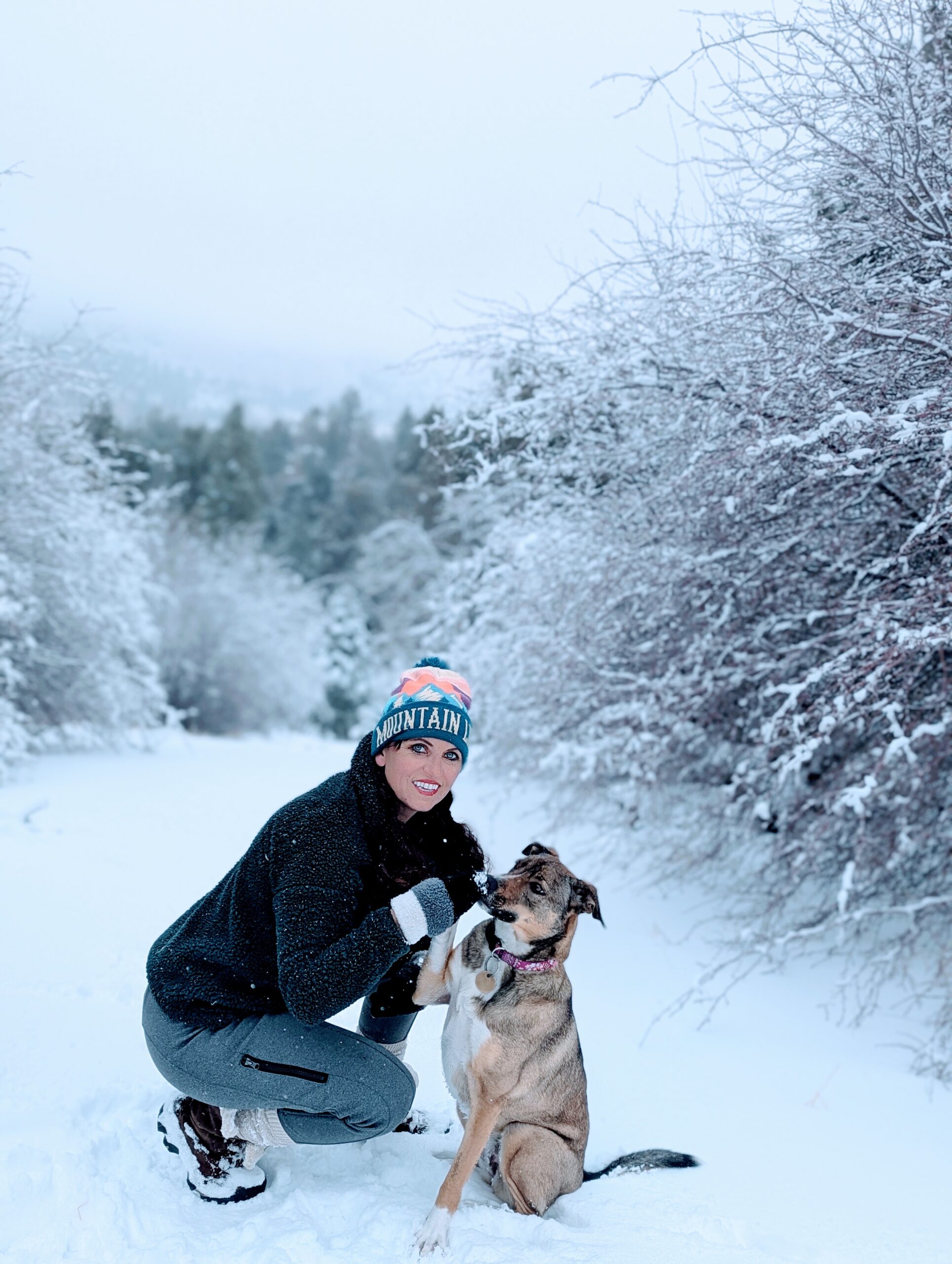
If you are visiting during a light snow year, this becomes even more valuable. Big Bear can look completely dry in one part of the valley while protected north-facing forest areas still hold plenty of snow. A local hiking and snowshoe guide who is on these trails constantly will usually know where to look.
That local knowledge is essentially what you are booking when you reserve a Hungry Mountaineer dog-friendly snow play experience, snowshoe tour or winter hike in Big Bear Lake.
Can My Dog Be Off Leash in the Snow?
Only where it is legal and only if your dog has genuinely excellent recall. Not “he usually comes back eventually.” Not “she’s friendly!” And definitely not “he has never seen a coyote before, so this should be interesting.”
Big Bear is still wildlife habitat. Coyotes live throughout the valley, and other wildlife is active throughout the winter. Rules regarding leashes can also vary depending on the specific National Forest recreation area, trail, developed site or property you are visiting, so check the rules for your exact location rather than assuming that “National Forest” automatically means unlimited off-leash dog park. Whether your dog is on leash or under reliable voice control where permitted, keep them close enough that you can intervene quickly.
And please pick up your dog’s poop. Yes, even when it lands in the snow. Few things destroy the magic of a pristine winter wonderland faster than discovering that what you thought was a pinecone is absolutely not a pinecone. Pack it out.
The Doodle Snow-Dingleberry Emergency
Now we need to discuss one of the great hazards of Big Bear dog-friendly snow play. Doodles. Specifically, doodle fur. Got a Bernedoodle named Waffles? A Sheepadoodle named Kevin? A Labradoodle named Moose who has never experienced adversity beyond receiving dinner eleven minutes late?
Pack a kitchen whisk. I am completely serious. Long curly doodle coats can collect snow like Velcro. After fifteen minutes of romping through fresh powder, your fluffy little adventure dog may come trotting back with dozens of compact snowballs attached to his legs, belly, feet and undercarriage. I affectionately call these snow dingleberries. They can become surprisingly heavy and uncomfortable, especially when snow balls up between the toes.
A cheap kitchen whisk is one of my favorite ridiculous-but-useful winter dog hacks. Gently run the whisk over those snowy curls and the little snowballs tend to break apart much faster than they do when you try pulling them off individually. Forgot your whisk? Big Bear has a Dollar Tree.
Your dog cannot come wandering through the store with you, but one human can make a quick whisk emergency run while the other stays with the pup.
What Should I Pack for My Dog for a Big Bear Winter Trip?
If you are planning Big Bear snow play with dogs, your dog’s winter packing list can become almost as ridiculous as your own.
Bring a properly fitted harness and leash, plenty of water, poop bags, towels, a warm coat if your dog needs one, snow boots if your dog tolerate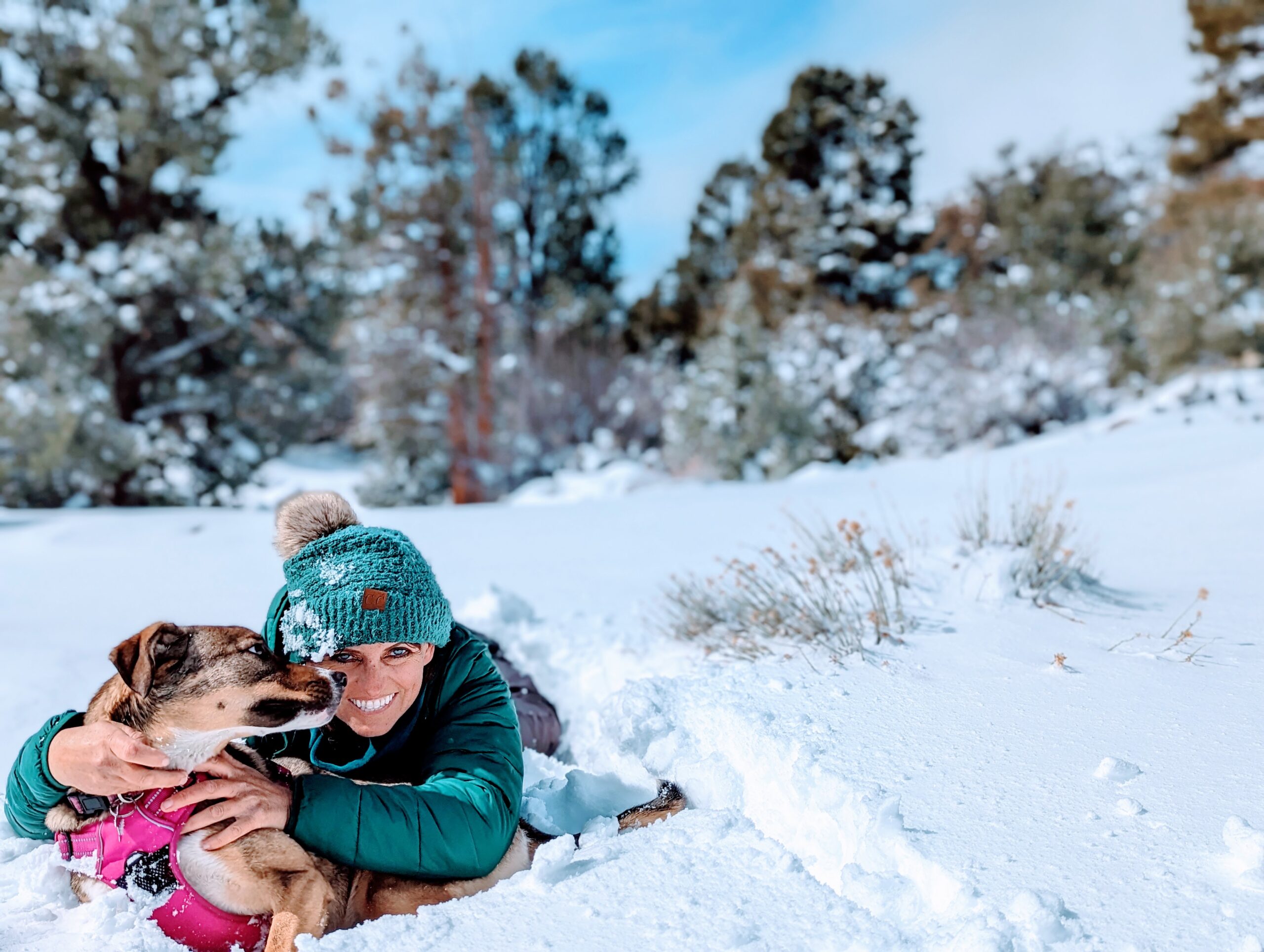 s them, paw wax, a blanket for the car and an extra dry towel. I am also a huge fan of a waterproof dog hammock or backseat cover. Because after two hours of dog-friendly snow play, your Adventure Pup will climb into your vehicle carrying approximately fourteen pounds of melted Big Bear inside her fur. There is no completely defeating Wet Dog Eau de Parfum, but you can put up a respectable fight.
I keep dog wipes and towels in the vehicle for exactly this reason. Dog-safe grooming wipes are especially convenient when you are staying in an Airbnb and it is far too cold to give Fido an entire bath every afternoon.
The Easiest Way to Enjoy Big Bear Dog-Friendly Snow Play
You absolutely can come to Big Bear Lake and figure all of this out yourself. You can research snow levels, hunt for legal parking, figure out which forest roads are accessible, wonder whether the snow you saw yesterday melted overnight and drive around with three children and one Labradoodle yelling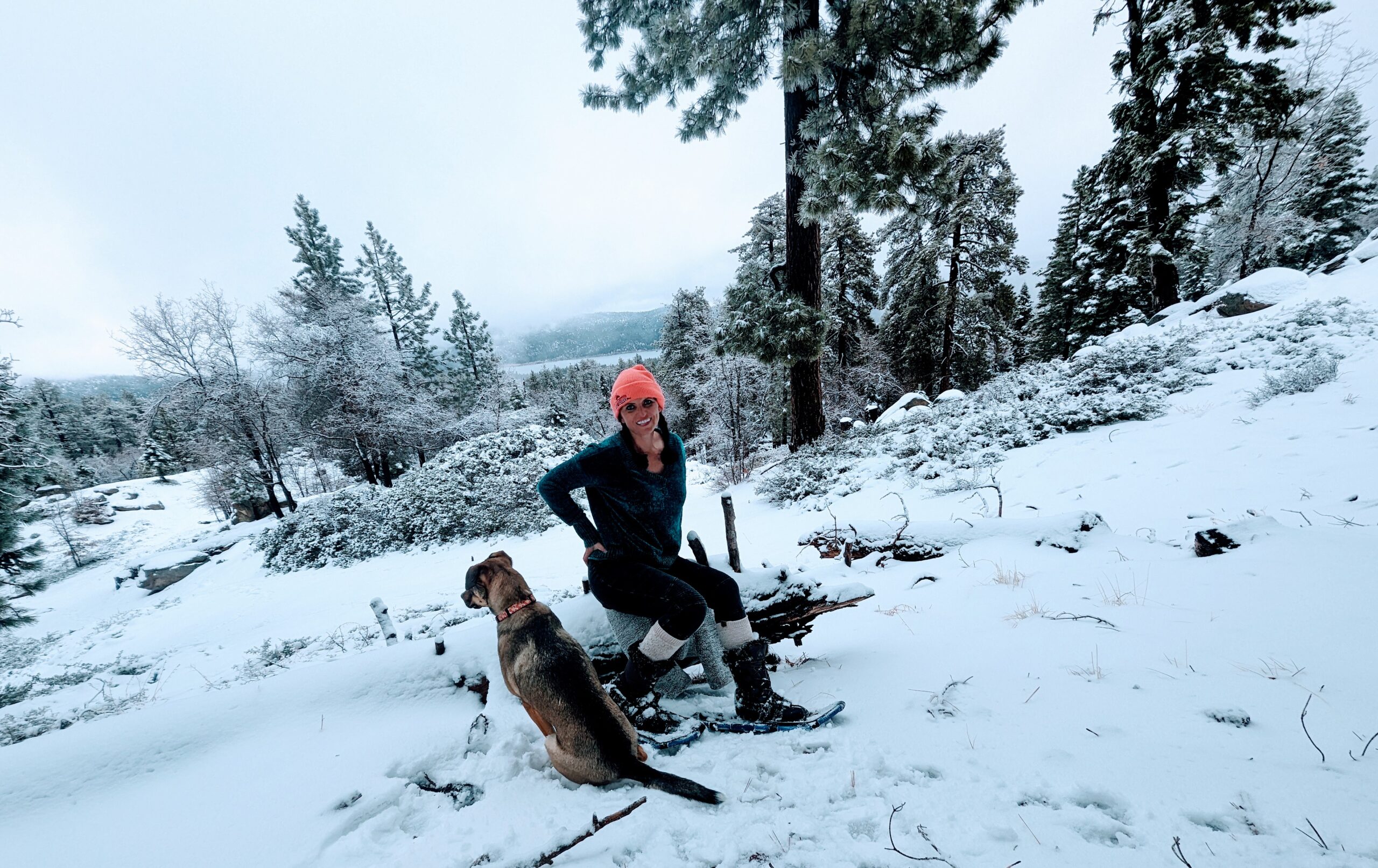 from the back seat.
Or you can come snowshoeing with me. Hungry Mountaineer Outdoor Adventures offers dog-friendly snow play, guided snowshoe tours and winter hikes in Big Bear Lake, and dogs are always invited.
For snow play, I take you away from busy roads and congested tourist areas and help you find a safe place to actually enjoy the snow. For snowshoe adventures, I choose the route based on snow depth, current conditions, your group’s ability and your dog.
Small groups can also arrange snowshoe rentals through me, so you do not necessarily need to purchase equipment for one weekend in the mountains.
And if Mother Nature decide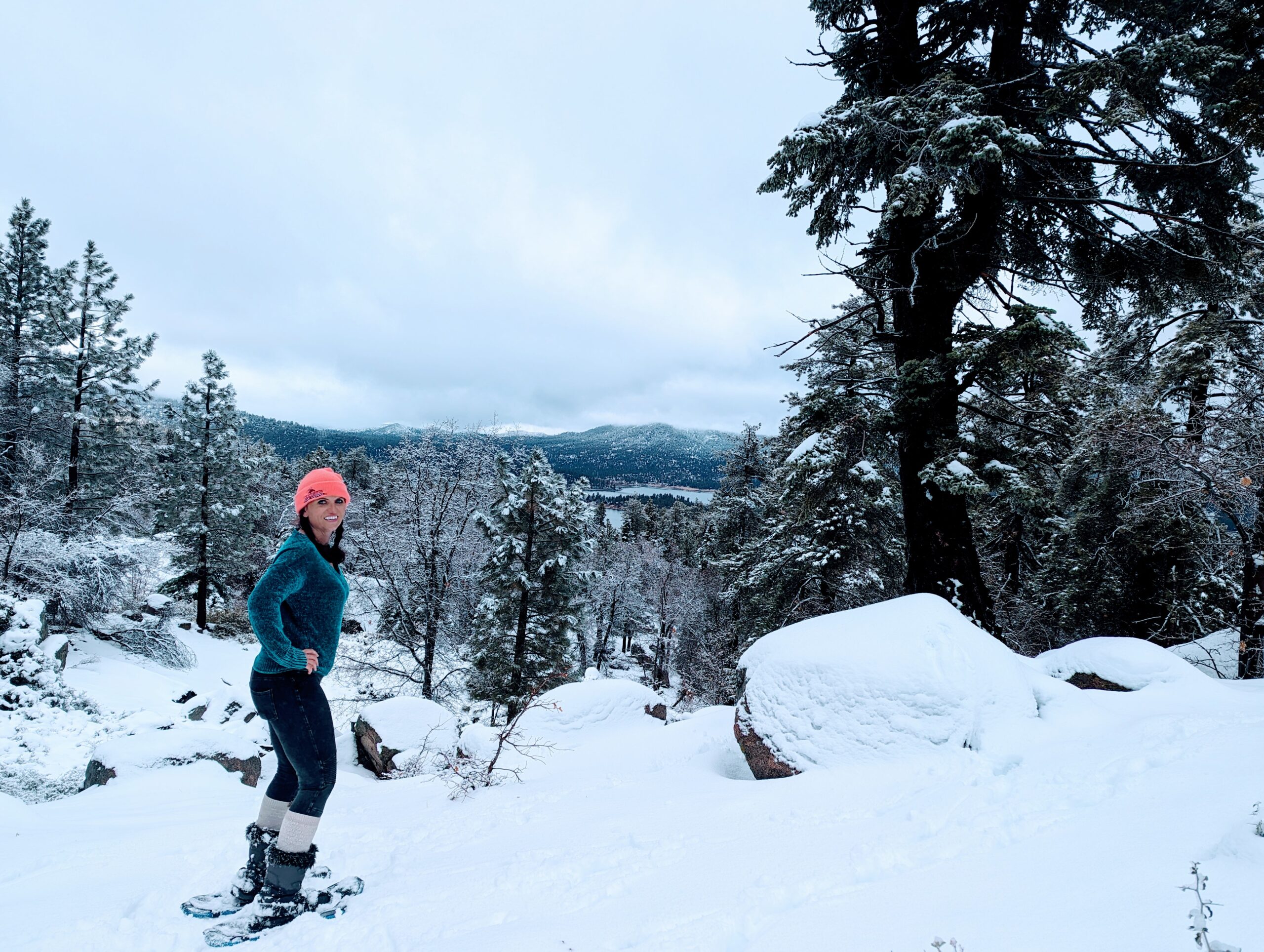 s that Southern California does not deserve much snow that week? We hike. I know these mountains in every season, and a guided winter hike can still get you into beautiful pine and oak forests, mountain viewpoints and whatever pockets of snow are hiding at higher elevations.
That is the beauty of booking with a local guide instead of booking something that depends entirely on whether six inches of snow happens to fall in one particular parking lot. So bring your kids. Bring Grandma. Bring your absurdly overdressed Husky named Kodiak.
Definitely bring your dog.
Because a dog-friendly Big Bear winter vacation is a lot more fun when your best adventure buddy actually gets to come on the adventure.