Attempting to visit the eastern Sierra in early springtime is no easy trip to plan. Info about the trails of the eastern Sierras in the first week of spring is very hard to find online. Any information about what kind of equipment you should bring is like a guessing game. Luckily for me, I bought a brand new backpack that carries my snowshoes, cat tracks, and so many liters of water. I could probably stick my entire twenty-five-pound dog in there in case of an emergency if I really needed to. This backpack is that big. I may have the big-ass backpack at long last to be prepared for all these snow treks but still, I would have liked to have known before packing for this trip to Mammoth Lakes a few simple facts. Like I could have actually ridden my mountain bike to the locked gate at Rock Creek Lake and saved myself six miles round-trip of hiking my first day here. Saying that the Eastern Sierra mountains are unbelievably beautiful, these few early weeks of spring break, even if you are trekking up a paved road, you could be cycling up. It was lovely for my soul this last week to trek through so many inches of fresh snow as I hiked into the backcountry.
Before I planned this trek into the eastern Sierra with great girlfriends for a week, I attempted to do a lot of research online and was able to find very little information about how much snow was at every single trailhead. I went into multiple Facebook groups and tried to make connections with people to get some information about which trails were looking trekable with snowshoes. It seems like there was just not a lot of information out there. Or the people who have been outside did not want to share the best snowy spots. This is ridiculous for someone like me, as a hardcore responsible hiker. I also consider myself a leave no trace outdoor person and I pick up everything from my dog’s poo to my own poo. It does not get more Leave No Trace outdoor responsible than that! I’m not a do it for the Insta hiker. I’m definitely one who feels we should all hike like adults and be responsible.
So where the hell can you snowshoe in the Mammoth Lakes area?
- It took meeting a very friendly ski patrol dude at Tamarack Lodge to actually get some information about where the best area to snowsh
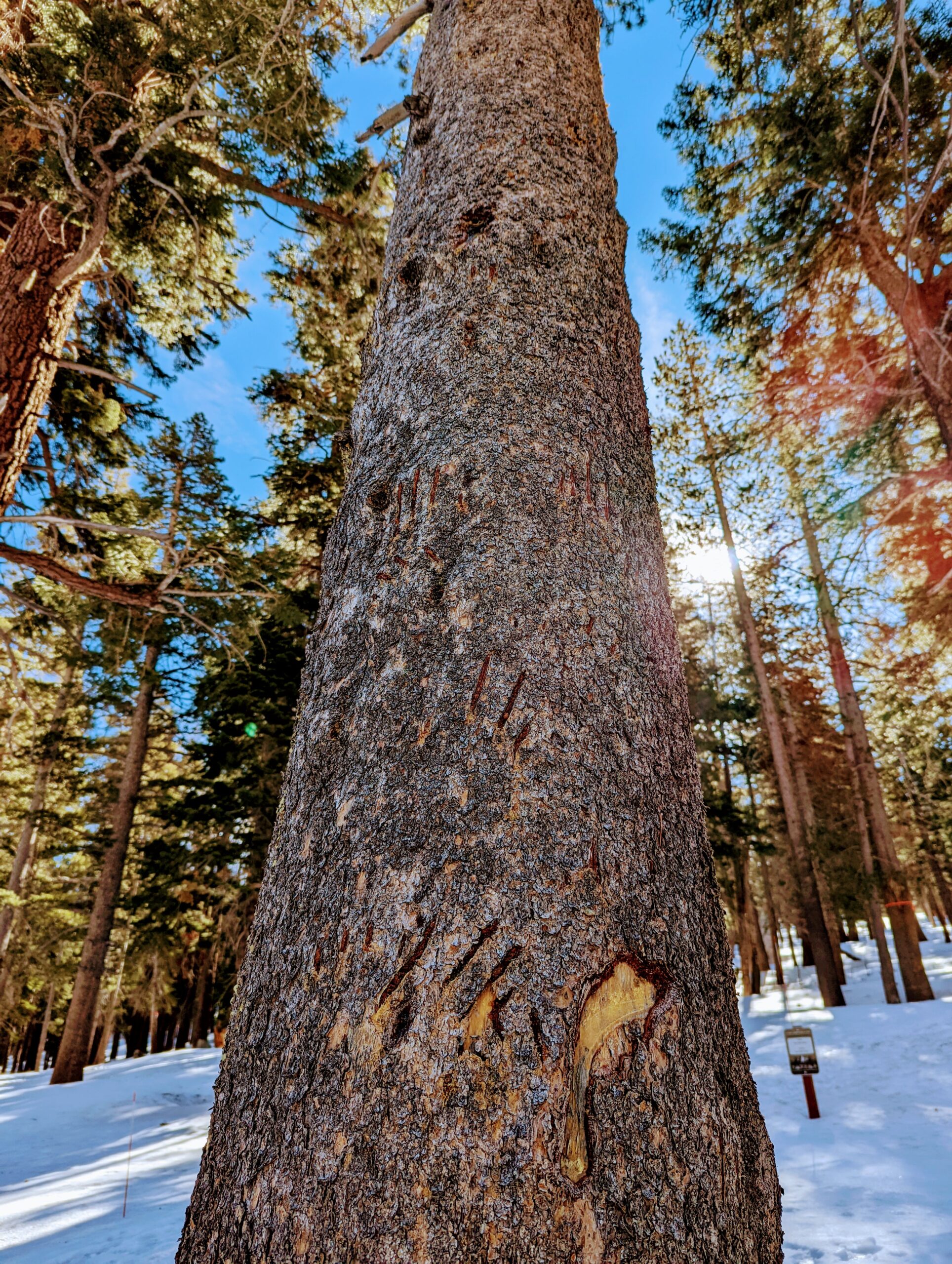
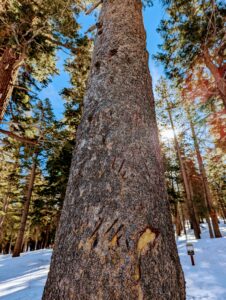 oe in Mammoth Lakes was. (And he also pointed out these awesome claw marks on this pine from when a bear had scaled this tree the summer before)
 - Tamarack Lodge in the Lake’s Basin is a great place to start. It’s an easy 5.5 round-trip snowshoe to Horseshoe Lake. Go early in the a.m. as the snow does get melty on warm spring days. Unfortunately, most of the wilderness back here is only for Nordic skiers, so you can stay on the main Lakes Basin Trail or go cross-country up towards Duck’s Pass if you know the way. Dogs must be on leash here during the winter months.
- I had always heard you could snowshoe back into Red’s Meadow but getting there is more complicated than one would think.
- Most years, Red’s Meadow is technically closed to snowshoers as there is an avalanche risk. This spring day, we were able to snowshoe back there as the snowpack was so low. We also checked the avalanche risk online that morning before we went snowshoeing. Always make safety a priority when adventuring in the backcountry of Mammoth Lakes.
- You also have to take the bus up to Main Lodge to start your snowshoe adventure. You could also pay thirty dollars for preferred parking instead of taking the bus. But with gas at over six dollars a gallon in the Mammoth Lakes area, I was quite happy to take public transportation on our adventures this last week. Make sure you pack a mask as masks are still required on public transportation.
The first few weeks of spring are the last few days of the season to break out those snowshoes. Don’t waste a second of those warm spring days. Forget about Palm Springs and Cabo. Don’t board a stinky, germ-filled airplane with recycled air full of other people’s farts. Spend your spring break outside in the snowy wilderness of Mammoth Lakes instead!