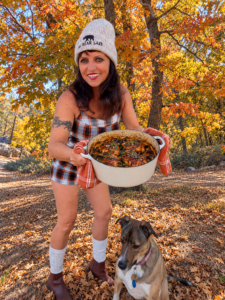
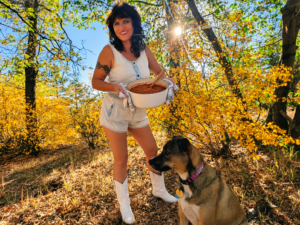
On today’s early morning snowshoe hike, I had to make up for forty-five days of absolutely no snow. Did I change my gently thrifted outdoor outfit three times? Maybe. In my defense, my snow pants eventually got soaked after wrestling in the snow with what I can only describe as my Catahoula Snow Monster. By noon, we were both soaking wet. I was ready to return to the cabin and start on this German Bee Cake recipe.
This is my dream winter scenario: Snowshoe miles in the morning, then coming home to cheap wine, bougie cheese, and a slice of German Bee Cake.
I like to cover all the food groups.
Grapes.
Cheese.
Honey.
Balanced diet, bitte.
Blizzard Baking: Why German Bee Cake Exists
Our poor little ski town here in Big Bear Lake, California, had only received six inches of snow by mid-February. Six inches.
That’s not winter.
That’s a light dusting.
Which expl ains why my stress level as Big Bear Lake’s premier Snow Sherpa and snowshoe guide was approaching DEFCON 1.
Luckily, this week winter finally returned with five glorious feet of snow at 6,000 feet elevation. And if you’re not baking during a blizzard, I ask you — are you even living?
Snowstorms Are Basically a Baking Holiday
Blizzard weather practically demands baking. Carbs don’t count during an active blizzard, right? You know you’re going to be shoveling snow for the next week anyway. You might as well fuel that activity with a proper German Bee Cake (Bienenstich).
The Germans understand this. There is just no such thing as a sad German pastry. If a dessert isn’t dripping with butter, honey, and sugar, a German grandmother in a dirndl somewhere is shaking her head in disappointment.
Meanwhile, on Birdie Boulevard

To be fair, everyone on Birdie Boulevard has been a little stressed this winter. Between snowstorms and life chaos, our neighborhood has basically become a German cake stress-eating support group.
Our small community has also been helping care for a neighbor with dementia because his caretaker seems to think everything is just fine. Spoiler: it is not fine.
They say it takes a village. No. It takes a boulevard.
And maybe several slices of German Honey Cake.
Cabin Life With Naughty Pets

When I’m not snowshoeing through the mountains, shoveling snow, or baking like a slightly sarcastic Bavarian fraulein, I’m usually hanging out with the animals in our cabin.
Our Norwegian Forest Cat with the adorable pink nose is basically the original Bad Bunny. Not evil. Just aggressively mischievous.
Earlier, he came in from playing in the snow, absolutely soaking wet and immediately jumped on top of his sleeping brother. Which I imagine is how Vikings greeted each other.
Teaching a Cat to Sit Is Impossible

Having the patience to teach the cat behaviors may be why I need to shove German Bee Cake at my face. I’ve been attempting to train Leo the Naughty Norwegian Forest Cat to sit when he comes inside, just like the dog does.
The goal is to keep wet snowy paws from turning my living room into an alpine swamp.
Teaching this behavior to a dog? Very easy. Teaching it to a cat?
Fraulein, bitte.
Have you ever tried to teach a cat anything? They look at you like you’re the intern.
My Obsession With German Bee Cake

Weeks before our ski town finally received real snow, I discovered this German Bee Cake recipe, also known as Bienenstich. I was immediately obsessed. However.
The recipe I originally found online was clearly written by someone who has never actually visited Germany. German pastries do not skimp on sugar.
Or butter.
Or honey.
This blogger somehow managed to create a Bienenstich that tasted like a polite suggestion instead of a dessert. Even more suspicious? She turned off the comments.
Always a red flag.
The Correct Way to Make German Bee Cake
So this version is my correct German Bee Cake recipe. Think Julia Child meets a mildly judgmental Bavarian auntie.

Because if you’re going to make Bienenstich, it should be:
- buttery
- honey-soaked
- almond-crunchy
- and filled with rich custard.
Exactly the way the Germans intended. Ja?
German Bee Cake (Bienenstich)
Classic German Bee Cake is a soft yeasted cake topped with caramelized honey almonds and filled with creamy custard.
It’s one of the most beloved traditional German desserts, and after one bite, you’ll understand why.
1/4 cup salted butter, room tempature, for the cake dough
1 packet of active dry yeast, for the cake dough
3/4 cup slightly warm milk to activate the yeast, for the cake dough
1/4 cup organic sugar, for the cake dough
2 eggs, for the cake dough
3 cups of flour, for the cake dough
1/2 teaspoon salt, for the cake dough
1/4 cup salted butter, for the almond layer
1/2 cup honey, for the almond layer
1/2 cup slivered almonds, for the almond layer
1/4 cup organic sugar, for the almond layer
1/4 cup extra honey, to garnish with at the end
Vanilla bean custard
2 egg yolks
1/4 cup of sugar
2 cups of milk
1 teaspoon vanilla bean paste
2 teaspoons cornstarch
The Non-Fake-News Version, Fraulein
So yes, this is how you make real German Bee Cake, also known as Bienenstich. Not the sad grocery store version that tastes like a sponge.
Put on some polka music, pour yourself a kaffee, and let’s bake like a proper German grandmother who judges your kneading technique.
Step 1: Wake Up the Yeast, Bitte

Warm your milk until lukewarm, not lava hot. If you kill the yeast, the Germans will know. Stir in a bit of sugar and sprinkle the yeast over the top. Let it sit for about 10 minutes until it gets foamy and bubbly.
If your yeast is not frothy by then, congratulations — you have murdered it. Start over, Fraulein.
Step 2: Build the Dough
In a large bowl combine:
- sifted flour
- the remaining sugar
- a pinch of salt
- Add:
- softened butter
- eggs
- your now bubbly yeast mixture
Knead the dough for about 10 minutes until it becomes smooth and elastic. Yes, ten minutes.
This is the arm workout portion of the recipe. Willkommen to German baking.
Step 3: First Rise (The Dough Nap)
Cover the dough and place it somewhere warm.
Let it rise for about two hours, or until it doubles in size and looks fluffy and optimistic about life.
Punch it down gently and knead it briefly to bring it back together.
Transfer the dough to a greased baking pan and let it rise again for another hour. Yes, another hour. Germans are patient people. At least when Hitler’s regime is not brainwashing them.
Step 4: Make the Almond Honey Topping
While the dough rises, let’s make the magic bee topping.
In a saucepan over medium heat melt:
- butter
- sugar
- honey
- a small pinch of salt
Stir until everything dissolves and your cabin smells like a European bakery.
Add the sliced almonds and stir until they’re coated in the buttery honey mixture.
Remove from heat and let it cool slightly.
Once your dough has finished its second rise, spoon this glorious almond mixture over the top.
Step 5: Bake the Cake
Preheat your oven to 350°F.
Bake the cake for 25–30 minutes until golden brown and beautifully caramelized. The almond topping should be crisp and slightly sticky, like something you’d find in a Bavarian café next to someone drinking espresso and judging tourists.
Let the cake cool completely. Yes, completely.
Do not rush this step, Fraulein.
Step 6: The Custard Filling
Heat milk with vanilla until warm.
In a separate bowl whisk together:
- egg yolks
- sugar
- cornstarch
Slowly pour the warm milk into the egg mixture while whisking. Then return everything to the saucepan and cook over medium heat, stirring constantly until the custard thickens. If you stop stirring, congratulations — you’ve made sweet scrambled eggs.
Once thick, cover the custard with plastic wrap pressed directly onto the surface so it doesn’t form a weird skin.
Let it cool completely until it becomes smooth, thick, and spreadable.
Step 7: Assemble Your Bienenstich
Once the cake is cool, slice it horizontally into two layers.
Spread the custard over the bottom layer.
Then gently place the top layer back on, almond side up, like the fancy European dessert it was always meant to be. I like to drizzle extra honey on top of the cake, because honey, the bees say it’s a super food, right?
Serve proudly. Preferably with kaffee.
Or schnapps.
Or both.